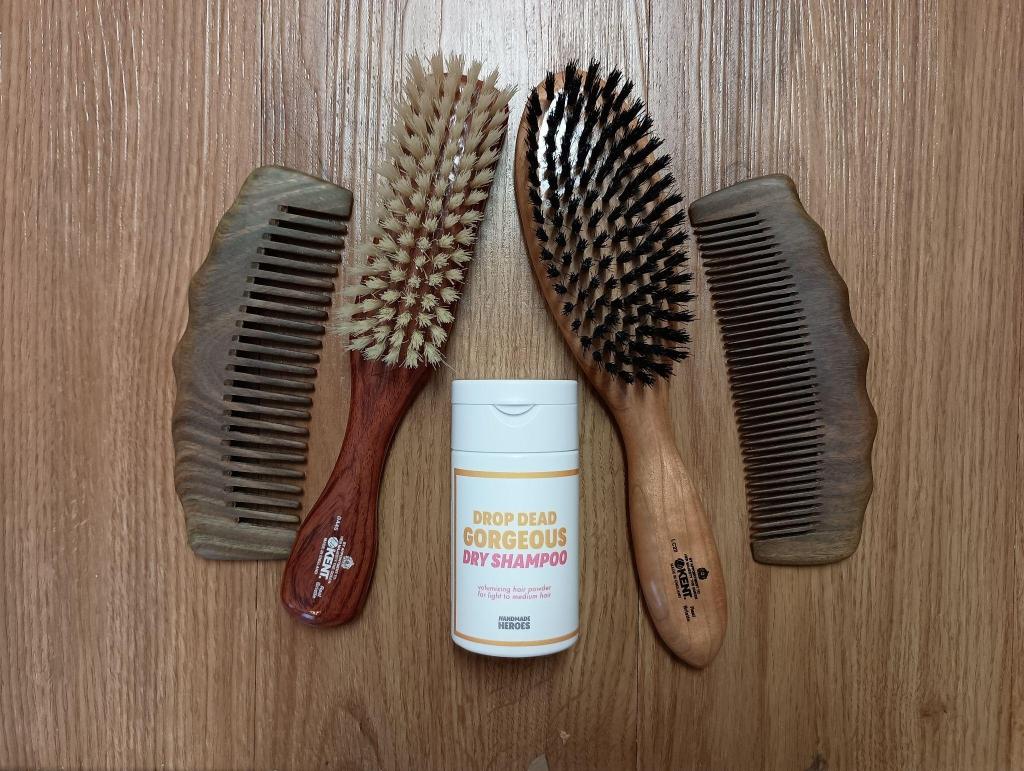
Hair powder, also sometimes referred to as volumizing powder, powder shampoo, or (incorrectly as) dry shampoo, is a staple and mainstay of my long-hair haircare routine. Hair powder allows me to manage my scalp’s oil production while also providing benefits such as exfoliation (not something I originally expected it to do), improve scalp circulation, and moderate body scent. Not only do I use it regularly but I use it completely in lieu of liquid shampoos. I just love how my scalp breathes so well now.
Making your own powder is probably the most fun way of doing this and it lets you tailor things to your liking. Getting bulk ingredients also saves you money in the long run and I am able to find all of what I need on Amazon or from local stores in my area. (Keep an eye out for when I post a recipe for my very own hair powder that I use on a regular basis!) No worries though if making powder mixes isn’t your cup of tea. The HandmadeHeroes -brand “Drop Dead Gorgeous Dry Shampoo” is a really affordable and clean alternative and it’s currently one that I still use. What I also like about it is its exact combination of ingredients that it includes as well as the ones it doesn’t.
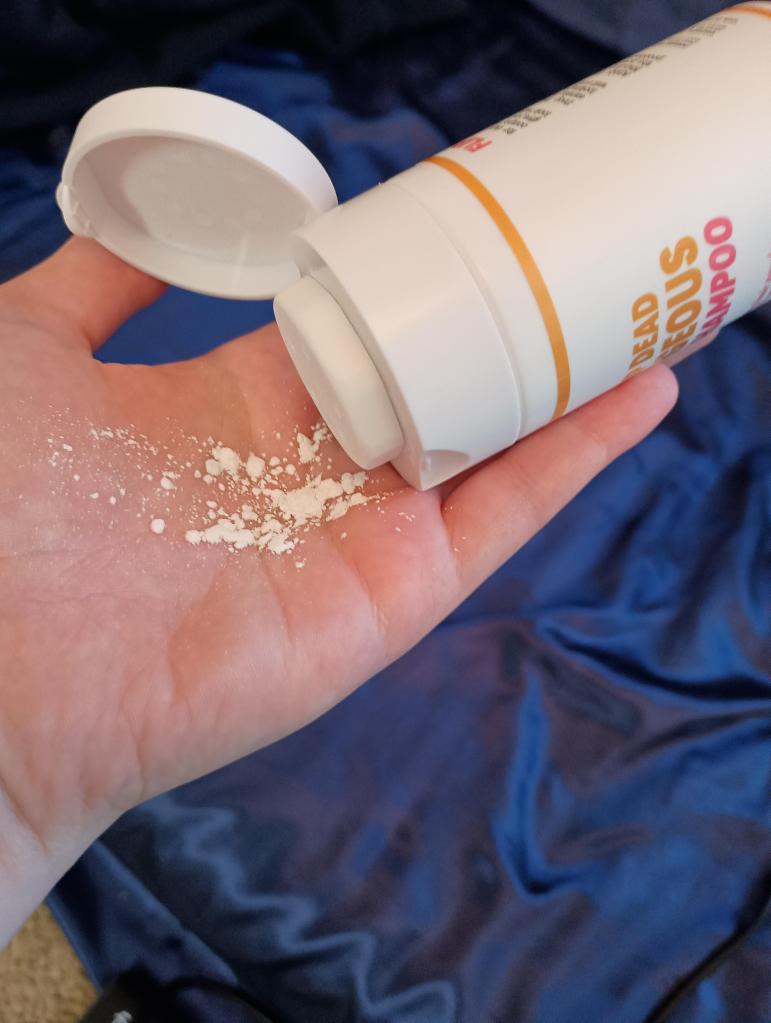
At 10 dollars for just under 2.0 oz per container, Drop Dead Gorgeous (DDG) is a much better bang for your buck than other brands, like Kitsch’s powder at 12 dollars for a measly 0.28 oz. DDG doesn’t come with a puff as Kitsch does, but this doesn’t prove an issue. Gently tapping some into your palm and rubbing it around makes for a mess-free application when using your fingertips to your roots, and there’s little to no waste of the powder that way. (I don’t recommend just shaking it over your head; you don’t need that much in one application anyways.)
If we look at the ingredients list of DDG, the first ingredient is rice powder, followed by a personal favorite, Kaolin clay powder. Depending on which version you get, the one for “Medium to Dark hair” or “Light to Medium hair” the ingredients will either include cocoa seed powder and charcoal powder before listing natural plant extracts, or just skip straight to those plant extracts. These are peppermint, pelargonium graveolens (geranium), eucalyptus, and lavender oils for the “Medium to Dark hair” blend, and coconut, curcumin, and vanilla plant extracts for the “Light to Medium hair” blend.
By comparison, Kitsch hair powder use corn starch and maranta arundinacea (arrowroot) powder as its first two ingredients, with a whole host of other powders and extracts. There’s nothing wrong with using corn starch, but it’s the arrowroot powder that is a big issue because it gets very pasty and tacky when hydrated with oil or water, a property that makes it excel in the world of handmade deodorant pastes but serves it poorly as a hair powder as hair powders are meant to be removed from the scalp and roots.
For those of you who are familiar with Katherine Haircare, the DDG hair powders should sound something like what she does; clay washes with rhassoul clay, amla powder, bhringraj powder, aloe vera powder, and essential oils of choice. If you’d like, you can find her recipe for the ratios of these ingredients at her website, in the PDF “Hair Growth Cheat Sheet” right on her homepage.
The difference between what her “clay wash” is and my “hair powder” is mostly just gets down to semantics and particular plant powders and extracts, but it is worthy to note that how we each use our powders is distinct. One isn’t necessarily better than the other, I just think it comes down to personal preference and also what your particular scalp type tells you what it needs. Listening to your scalp is huge and I’ve found experimentation with recipes and application has taught me a lot about my own scalp’s preferences. It’s also helped me understand and have a greater appreciation for all the other ways women, past and present, have used clay and flours to keep themselves fresh.
Katherine Haircare’s suggested instructions for regular use have you take her already prepped powders and mix it up with some water. This is then poured (notice how it is now wet and is runny enough to be poured, rather than a paste or still dry) into an applicator bottle for getting it down to you roots. This is then rinsed out with water after letting sit for 1-2 minutes, and followed up by an apple cider vinegar rinse of her own recipe.
My hair powder (DDG or my own mix) I prefer to apply dry in small amounts, massaging into my roots as I go, and I tend to let it sit for about 5 minutes (or more if I forget it’s there!). The other big difference is that I then use my combs and brushes to pull it through my hair and thoroughly pull it all out, and I often go for days before rinsing with any water because I already pulled the clay and flours out of my hair. Rinsing with water then just becomes a final way to ensure all residue (if any) is removed and to flush my hair follicles on a weekly basis. In this way I haven’t had any scalp zits or clogged pores like I always used to have, and that’s partly because my scalp isn’t so oily anymore. The water-only rinse with light use of powder each day keeps things exfoliated and clean while letting my scalp regulate itself.
Now that my scalp has stabilized, just one application of powder and combing it out is plenty enough for my needs. In general my process is meant to be done in several passes if there’s more oil leftover to cleanse out, such as when I am on my period or back when I had first dropped shampoo from my regimen and my scalp was still overproducing oil still expecting to have to compensate for the shampoo. I’ll note here the reason why shampoo, even gentle formulations or dilutions of strong ones will cause your scalp to feel the need to overcompensate is because it removes all oil from the scalp and even from out of the follicles themselves. Katherine’s clay wash or my hair powder both avoids this issue by simply letting the clay and other ingredients grab onto excess oils while leaving a mild layer on the surface of the scalp and in the follicles, leaving protection and nourishment for grown and baby hairs alike.
How I comb and brush my powder through and out of my hair is a process I will share soon. For some it may be more than they want to do, but I find that how long it takes comes out in the wash. Because I am not taking showers daily or even every other day, or having to worry about excess oil, or the next shower-time necessitating frequent restyling, it frees up many mornings and evenings. It actually comes as a time savings across the week (including how short the actual water rinse is on the weekend), though the actual brushing might take longer.
I will also share how to keep your brushes and combs clean so that they don’t get gunky or gross, something that tickles me because it essentially involves brushing your brushes. XD
Thanks for joining me 🙂

 Natalie's Hair, Horses and Harps
Leave a comment